Rupture & Repair
It’s Complicated Conference, Berlin
Conference Welcome – June 6th 2026
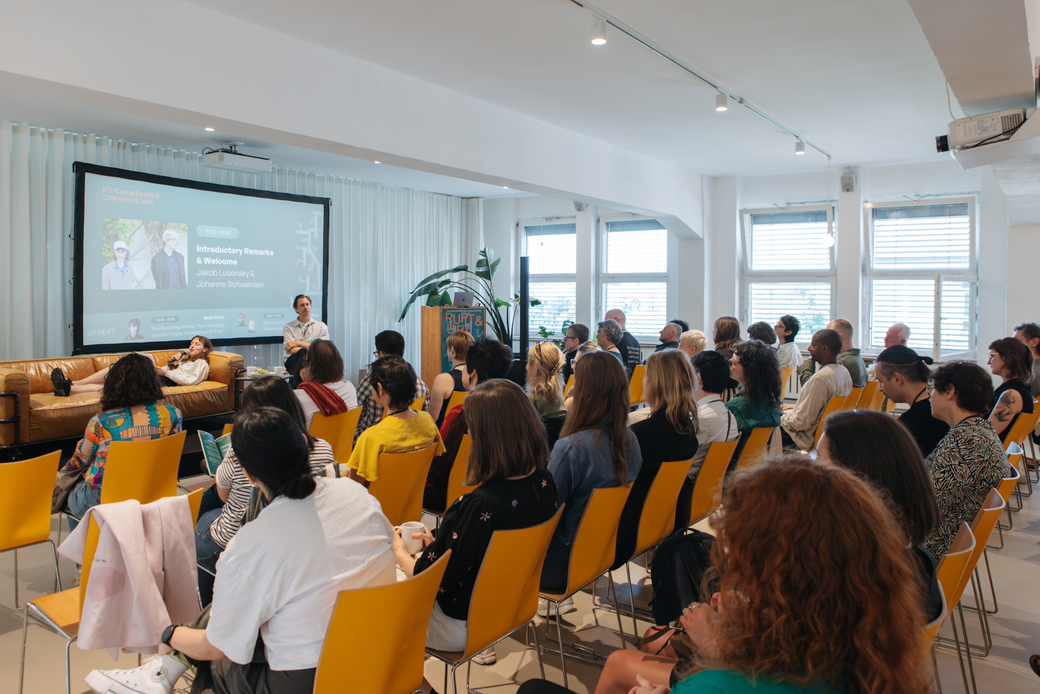
The following is a lightly edited transcript of the opening address delivered by Jakob Lusensky, co-founder of It’s Complicated, at the third IC International Psychotherapist Conference in Berlin on 6 June 2026. This address explores what holds communities together, what psychotherapy can and cannot offer in an age of artificial intelligence, and what it means to remain profoundly human.
What holds us together when things come apart
Psychotherapy can indeed offer support, help, and some would say healing when an individual’s life breaks down. But what holds the us together when things fall apart?
Healing “the us,” the collective if you like, has been the aspiration of political ideologies, religions, and ritualistic practices throughout human history. Human beings have always lived and been supported by stories larger than themselves. Stories that have provided meaning individually, but also acted as the glue that held societies together.
Today, psychotherapy offers very little in the way of a collective story. The focus lies rather on the individual: individuation, personal development, trauma, self-realization, becoming who you are.
Change outside the individual, when reflected upon at all, is often linked to the belief that collective change begins with one person at a time. One person goes to therapy, withdraws some of their projections, works through some of their trauma, learns to empathize a little more deeply, and this may create a ripple effect in relationships, families, communities, and society at large.
It is a beautiful story.
My teacher in Zurich, Murray Stein, once told me a story about the Jungian analyst Max Zeller, who lived here in Berlin in the 1930s, survived the concentration camps, fled to Los Angeles and later became an analyst in Zurich.
After the second world war, Zeller found himself deeply troubled by a question, (that I also pondered):
“What am I doing as an analyst?”
With all the suffering in the world, what difference does it make to see twenty or twenty-five patients a week?
During a visit to Zurich, he brought this question to Jung. The night before leaving, he had a dream.
In the dream he saw a temple of vast dimensions under construction. Everywhere people were building enormous pillars. As far as he could see, in every direction, people were working on the same structure. He too was building on one of the pillars.
When he told Jung the dream, Jung replied:
“That is the temple we are all building.”
People are building it in India, in China, in Russia, all over the world.
Then Zeller asked:
“How long will it take until it is completed?”
Jung replied:
“About six hundred years.”
Zeller asked:
“Where do you know this from?”
Jung replied, “From dreams. From other people’s dreams and from my own. This new religion will come together as far as we can see.”
I loved this story when I first heard it. It felt comforting.
But, over the years I have become more sceptical of both Jung as some sort of prophet, as well the underlying promise of his interpretation. Not because I doubt the value of psychotherapy, or dream work (something I engage in with almost all my patients), but because I am not convinced that I neither have the patience or that we have the time to wait for another, what is it now, five hundred twenty years for the temple to be completed. I don’t think the story itself gives us an adequate response to the burning questions facing us today. Especially the question of:
What does it mean to be a human self?
This question is now standing directly in front of us as we find ourselves face to face with a new type of artificial intelligence. A technology capable of imitating therapeutic conversation, generating images, composing music, and processing information at a scale no human being can.
Standing face to face with AI forces us to answer a question we have afforded avoiding for quite some time:
What is it that a human being can offer that a machine cannot?
I don’t have the answer.
But one thing I do know—from my own experience as a therapist, as a patient, and a person—is that a human life is indeed complicated.
To be human is inseparable from being vulnerable, imperfect, and limited by the fact of inhabiting a body.
The process of becoming more human is not a process of optimization. It is a process of rupture and repair.
A process I witness daily in the consulting room, but also in my own life, in my friendships, and not least in my relationship with Johanne and my dear and hardworking colleagues at It’s Complicated.
Rupture and Repair is a process that AI knows nothing about. Not because it lacks intelligence, but because it does not suffer, love, grieve, age, forgive, fail, or begin again. It’s algorithmic focus and artificial life is a loop of constant improvement and imitation (by the way, there are humans stuck in that loop as well).
Our current Pope, Leo XIV recently published an encyclical on Artificial intelligence entitled Magnifica Humanitas – On safeguarding the human person in the time of Artificial Intelligence. It’s a profound read that formulates the challenge we’re facing today. Pope Leo writes:
“In the era of artificial intelligence, when human dignity is threatened by new forms of dehumanization, ours is the pressing duty to remain profoundly human..n. True progress always stems from a heart open to others, an intelligence willing to listen, and a will that seeks what unites rather than what separates.”
(par. 15)
To remain profoundly human.
A beautiful task. A complicated ask. Because being human is also to remain in relationship with other human beings. Perhaps something more important than ever before, as we spend increasing amounts of our lives talking to machines.
On my own I can appear strong, but I am actually at my weakest when I imagine myself as self-sufficient, in need of no one. Life eventually catches up with that illusion. Sooner or later, we all grow old, need help, care, patience, and the forgiveness of another person.
And this brings us back to the question I began with.
What holds the “us” together?
The risk, if we do not ask this question, is that psychotherapy itself becomes another force of individualization and atomization. We become so fascinated by our differences, our personal stories, our individuation, and our identities that we lose sight of what we fundamentally share.
Our common humanity.
The Danish philosopher Søren Kierkegaard writes in Works of Love:
“No one must look too long at the difference, so that, cowardly or arrogantly, he forgets that he is human; no one through special dissimilarity is exempt from being human. He is first human, and then he is the one who differs.”
So, what does it mean to be human?
Perhaps we should ask nature. Nature is, after all, the master intelligence that artificial intelligence longs to imitate but cannot become. It’s where we come from and where we end.
Living in harmony with nature, Tao, God, Self—call it what you want —has always been one of the deepest longings in humans. Which brings me to the image that has been accompanying me in preparation for this conference.
At last year’s conference I spoke about ants. I had the strange experience that our conference had turned into an intelligent ant colony. Everyone moving, exchanging, building, carrying, collaborating. This year the insect that flew into my imagination was that of a bee.
A few weeks ago, a patient of mine—who has given me the permission to share this story—returned from a psychedelic retreat.
He had hoped for insight, transformation, perhaps even revelation.
Instead, what he encountered with was a bee.
One single bee hovering a few inches from his face, and this went on for a long time.
Later he laughed:
“I came all this way for a mystical experience and all I got was a goddamn bee.”
A bee spends its life moving from flower to flower collecting nectar. But for whom? For itself? Or for the hive?
My patient and I could recognise something of himself in that image. Moving from experience to experience. Collecting insights. Collecting moments. Yet feeling deeply alone and isolated. Yearning for community.
And perhaps this is not only his story. Perhaps it is also ours. We have become remarkably skilled at collecting experiences.
But less certain about where the hive is.
Less certain about what holds it all together.
Less certain about who we are gathering all this nectar for.
Because bees do not create honey alone. Honey is a collective achievement. Something that is created through cross-pollination and busy bees working together. It’s nothing an individual bee can create by itself.
Perhaps something similar is true of us humans in this room. Perhaps the most important thing happening this weekend will not occur on this stage. Perhaps it will happen during lunch. Over coffee. In conversation, or In a disagreement.
In the countless small acts of exchange and communion that happen whenever thoughtful people gather together.
So I’ll invite you to let the hive be one image for our time together.
It’s also a reminder that at its foundation, It’s Complicated, is not yet another marketplace or therapist directory. It is foremost a community of humans.
We have local hives in Berlin, Amsterdam, Lisbon, and many other cities.
We have people gathering around Jungian psychology, psychedelics, ADHD, IFS, couples work, and countless other topics. And what inspires me most is when these communities grow beyond us. That is what healthy ecosystems do. They create the conditions for new life to emerge.
Ok. One final warning before we all become too enthusiastic about the honey.
Nature should never be idealized.
Bee colonies can be remarkably ruthless.
I recently learned that when a queen bee loses the confidence of the hive, worker bees sometimes perform what beekeepers call a “murder ball”—a coordinated execution of the queen.
Bad news for you, Johanne.
So perhaps we should not identify completely with the bee.
Let us rather remain human. Let’s enjoy these two days together. As we learn from one another about the rupture and repair process.
And above all, let’s do our best to try remain, profoundly human.
