
85% of clients would still choose a human therapist over AI, yet almost half of those who use it find a chatbot easier to open up to.
That tension runs through The Third in the Room, It’s Complicated’s 2026 AI in therapy report, published today. In September and October 2026, we surveyed 324 clients and therapy seekers in 29 European countries and 300 therapists in 26 countries.
Our 2025 report, AI in and Outside the Therapy Room, looked at adoption: who uses AI, what for, and what benefits and concerns people see. A year on, AI is already in the therapy room. Clients bring it up in sessions or arrive with thoughts shaped by it, and some therapists now use it for clinical tasks such as session notes. So this year, we asked what happens to the relationship between client and therapist once AI is already there. (Here, “AI” means generative AI, such as ChatGPT and other chatbots, and the tools built on them.)
We set out to answer four questions:
- Is it easier to tell a machine things that are hard to say to another person?
- Are people becoming attached to their AI tools?
- Does AI lead people towards therapy or away from it, and do they talk about it once they’re there?
- Do they still want a human therapist?
The survey also comes as new rules take effect. Since 2 August 2026, the EU AI Act has required chatbots to tell people they are talking to AI, so we asked clients and therapists whether that goes far enough.
This year, two expert contributors respond to the findings. Lea Maria Schäfer, clinical psychologist and AI in therapy researcher, comments on them throughout the report, and Dr Aaron Balick, psychotherapist and author, reflects on what they mean for therapy.
Key figures at a glance
| Finding | Figure |
|---|---|
| Clients who have used AI for their mental health | 57% (52% in 2025) |
| Therapists who have used AI in their practice | 65% (51% in 2025) |
| Clients who would still want a human therapist even if AI could fully match one | 85% |
| Therapists who say AI could never fully replace them | 72% |
| AI-using clients in therapy who haven’t talked about it with their therapist | About 6 in 10 |
| Therapists whose clients have mentioned using AI | 72% (65% in 2025) |
| AI-using clients who find a chatbot easier to open up to than a therapist | 47% |
| Therapists who have seen a client show signs of over-reliance on AI | 1 in 4 |
Every finding, how things have changed since 2025, and what clinical psychologist Lea Maria Schäfer and psychotherapist Dr Aaron Balick make of it.
As therapists ourselves, and the founders of It’s Complicated, we recognise the discomfort that AI brings for therapists and clients alike. Almost half of the clients who use AI find it easier to open up to a chatbot than to a therapist. That deserves our curiosity, not our defensiveness.
Johanne Schwensen, Co-founder and Chief Clinical Officer, and Jakob Lusensky, Co-founder
Is it easier to open up to AI than a therapist?
For many people, yes. Almost half of clients who use AI (47%) find it easier to open up to a chatbot than to a therapist. Only 13% of them find it harder.
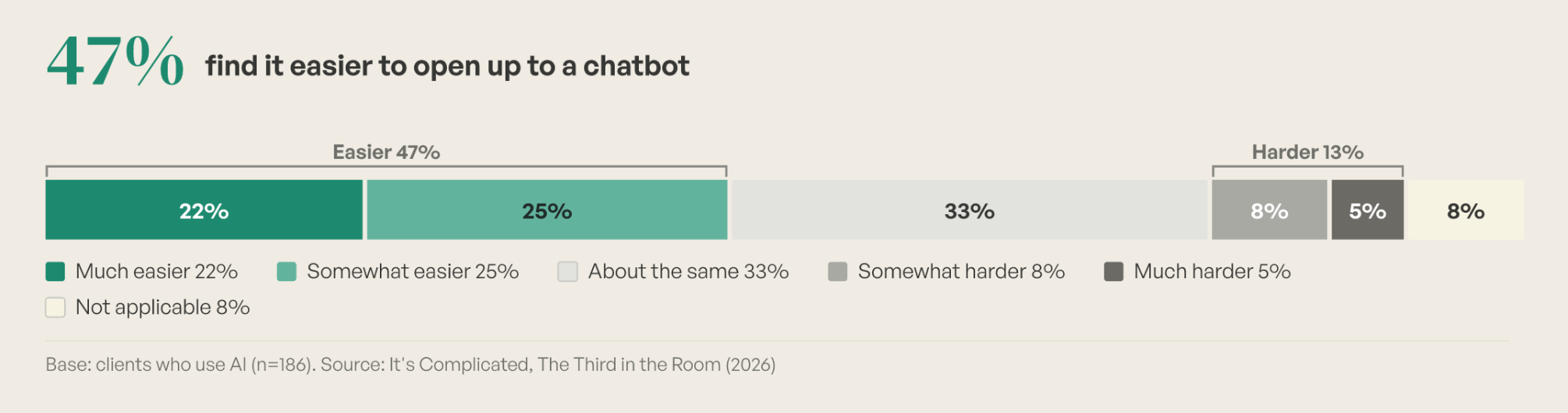
Why? Mostly because it’s there. Asked for their main reason for using AI, almost half of clients who answered (48%) say it’s faster or more flexible, and 15% don’t have a therapist nearby. Cost matters less than you might expect: it’s the main reason for only 8%. As one client in Germany put it: “Opening a chat requires a heck of a lot less executive function than trying to schedule an appointment with a human.”
But that ease has a downside. 69% of clients worry that AI reinforces their thinking rather than challenging it. And 96% of those who use AI for their mental health use general chatbots like ChatGPT, not tools built for mental health.
Most clients still want a human therapist
Still, most people want a person. 85% of clients would still want a human therapist even if AI could fully match one. And 72% of therapists say AI could never fully replace them.
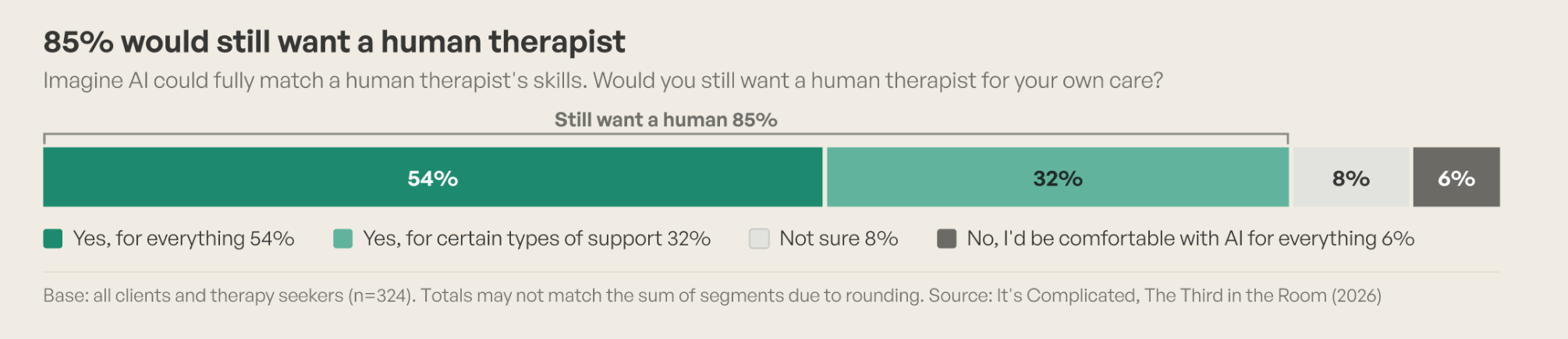
At the same time, more people are drawing a line. The share of clients who wouldn’t want AI involved in their therapy at all has more than doubled, from 12% to 27%.
If that sounds contradictory, clients feel it too. “While I freely use AI for support there’s clearly a contradiction that I wouldn’t want a therapist to use it,” said one client in the UK.
This finding makes me happy and reinforces my view of AI as a tool: a means to an end, rather than an end in itself. Human therapists bring embodiment, shared context, and a relationship with a history. The growing scepticism is healthy and encourages us to assess carefully where AI adds value.
Lea Maria Schäfer, Clinical Psychologist and AI in Therapy Researcher, expert contributor to the report
AI as a way into therapy, often left unspoken
Does AI lead people towards therapy or away from it? Both, but more often towards it. 32% of people who use AI say it made them more likely to see a therapist. For 23% of them, it delayed or replaced therapy for a while.
For clients already in therapy, AI often works as preparation. A third of clients who use it (34%) arrive at sessions more prepared, 30% bring new things to explore, and 22% spend less session time on certain things. And the top wish for AI is help finding the right therapist, chosen by 52% of clients, up from 34% last year.
Yet it often goes unspoken. About 6 in 10 clients in therapy who use AI haven’t talked about it with their therapist, even though 72% of therapists say clients have mentioned it.
When AI support becomes reliance
11% of people who use AI have felt emotionally attached to a chatbot. How often you use it seems to matter: among those who use it weekly or more, it’s about 1 in 5, compared with 3% of lighter users.
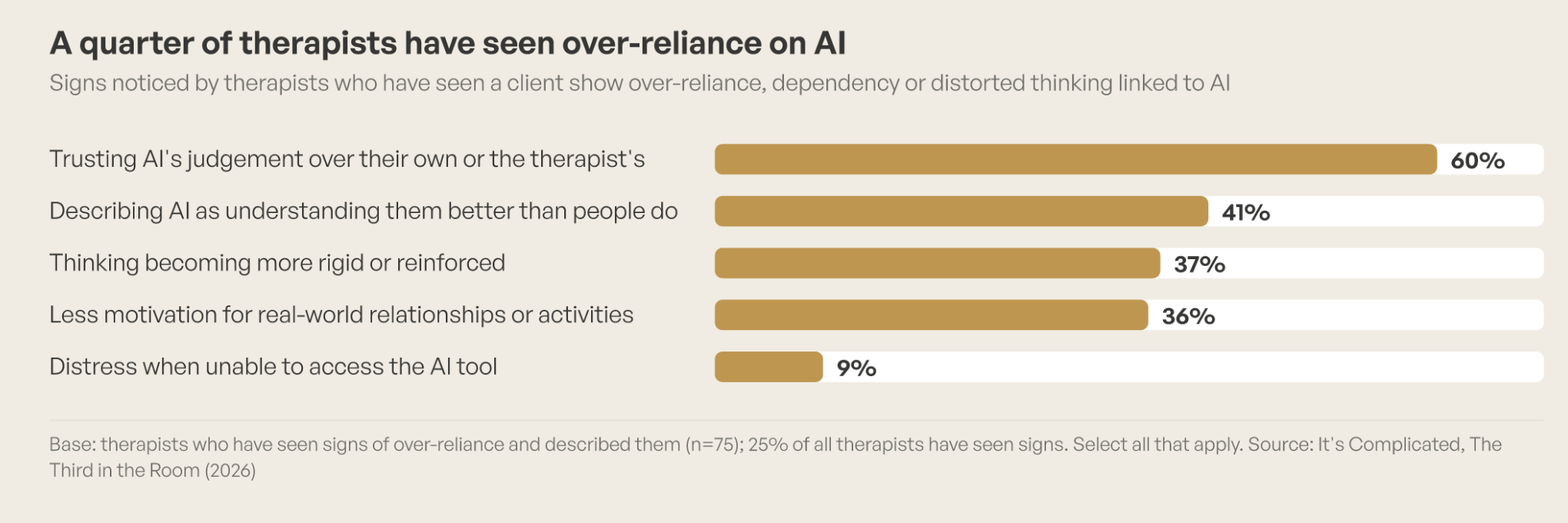
Therapists are noticing too. A quarter of therapists have seen a client become over-reliant on AI. The most common sign is trusting AI’s judgement over their own or their therapist’s, seen by 60% of those therapists. 41% of them have heard clients say AI understands them better than people do, and 37% have seen thinking become more rigid.
What to do with this
The full report ends with two practical guides: a 9-point checklist for therapists on AI in their practice, and 7 questions clients can ask their therapist about AI. Both are in the download at the end of this post.
Looking ahead
For many clients and therapists, AI is already the third in the room, even when nobody mentions it. What the findings show is that people still want a person at the centre of their care, and see AI as useful around the edges.
The question is no longer whether AI belongs in mental health care, but who shapes the part it plays. We think clients and therapists should, and we hope this report helps them talk about it more openly, together.
If you’d like to know how we use AI at It’s Complicated, read our approach to AI.
Includes the 9-point checklist for therapists and the 7 questions for clients, along with every finding and the full method.
Thank you to the 624 clients, therapy seekers and therapists who took the time to answer this year’s surveys. Many shared honest, personal experiences in their own words, and the report would not exist without them. Thanks also to Lea Maria Schäfer and Dr Aaron Balick for their perspectives.
Want to take part in the 2027 survey, or talk about the findings? Get in touch at press@complicated.life.
Method and how to cite
Method: two online surveys ran in September and October 2026, one for clients and therapy seekers (324 respondents in 29 European countries) and one for therapists (300 respondents in 26 countries). Both were shared with our audience and community. People chose to take part, so the findings are a snapshot of the people we reached rather than a representative sample. Most questions were compulsory this year, so changes since 2025 show the direction rather than exact differences.
How to cite this report: It’s Complicated (2026). The Third in the Room: When AI enters the therapeutic relationship. 2026 AI in therapy report. complicated.life/ai-report-2026
Sources
- It’s Complicated (2026). The Third in the Room: When AI enters the therapeutic relationship. 2026 AI in therapy report.
- European Union (2024). Regulation (EU) 2024/1689 (Artificial Intelligence Act), Article 50.
- European Union (2016). Regulation (EU) 2016/679 (General Data Protection Regulation), Articles 4(15) and 9.
It is It’s Complicated’s 2026 AI in therapy report. In September and October 2026 it surveyed 324 clients and therapy seekers in 29 European countries and 300 therapists in 26 countries, asking what happens to the relationship between client and therapist once generative AI, such as ChatGPT, is already part of it.
Most do. 85% of clients in the 2026 survey would still want a human therapist even if AI could fully match one, and 72% of therapists say AI could never fully replace them. The share of clients who would not want AI involved in their therapy at all has more than doubled, from 12% to 27%.
Mostly because it is there. 47% of clients who use AI find a chatbot easier to open up to, and the main reasons given are speed and flexibility (48%) or having no therapist nearby (15%). Cost is the main reason for only 8%. At the same time, 69% worry AI reinforces their thinking rather than challenging it.
11% of people who use AI have felt emotionally attached to a chatbot, rising to about 1 in 5 among weekly users, compared with 3% of lighter users. A quarter of therapists have seen a client become over-reliant on AI, most often by trusting its judgement over their own or their therapist’s.
Help finding the right therapist is the top thing clients want from AI. It’s Complicated connects clients with independent therapists across Europe in more than 60 languages. You can search the directory yourself or use the matching service, and read our approach to AI.

