There is no single best practice management software for therapists in Europe. The right one depends on where you practise, how your clients pay and where they live. For a self-pay private practice, check EU hosting and a data processing agreement first, then booking, notes, forms, invoicing and video. Below, ten options are compared by who they suit, trade-offs included.
Written by Johanne Schwensen, clinical psychologist and co-founder of It’s Complicated, one of the tools below. Every competitor fact comes from that vendor’s own pages, checked on 11 November 2026. Tools are listed alphabetically, not ranked.
If you are a psychologist or counsellor in private practice, you have probably met the same problem from two sides. Many software reviews are written for US clinics, so they rank tools on insurance billing you will never do. And many European options describe themselves in nearly identical words: secure, GDPR-compliant, all-in-one. This comparison tries to be more useful than that by asking one question per tool: who is this actually built for, and what do you give up if you choose it?
How we compared the tools
Software for psychologists in private practice has to do two jobs. It has to make the week run smoothly, and it has to handle health data in a way you can defend to a client or a regulator. So each tool below was checked on the same points, using only what the vendor publishes:
- Data hosting and transfers: where the vendor says data is stored, and whether it says data may leave the EU.
- Data processing agreement (DPA): whether one is published or can be signed, as Article 28 GDPR requires.
- The weekly basics: online booking, note templates, intake and consent forms, invoicing with online payment, video sessions.
- Price: the entry price per month as listed in November 2026. Several vendors were running promotions, so we quote the regular price.
- Fit: who the vendor says it serves, and what that means for a solo self-pay practice in Europe.
We don’t rate anyone’s security. We report what each company says about itself and link to the page so you can read it yourself.
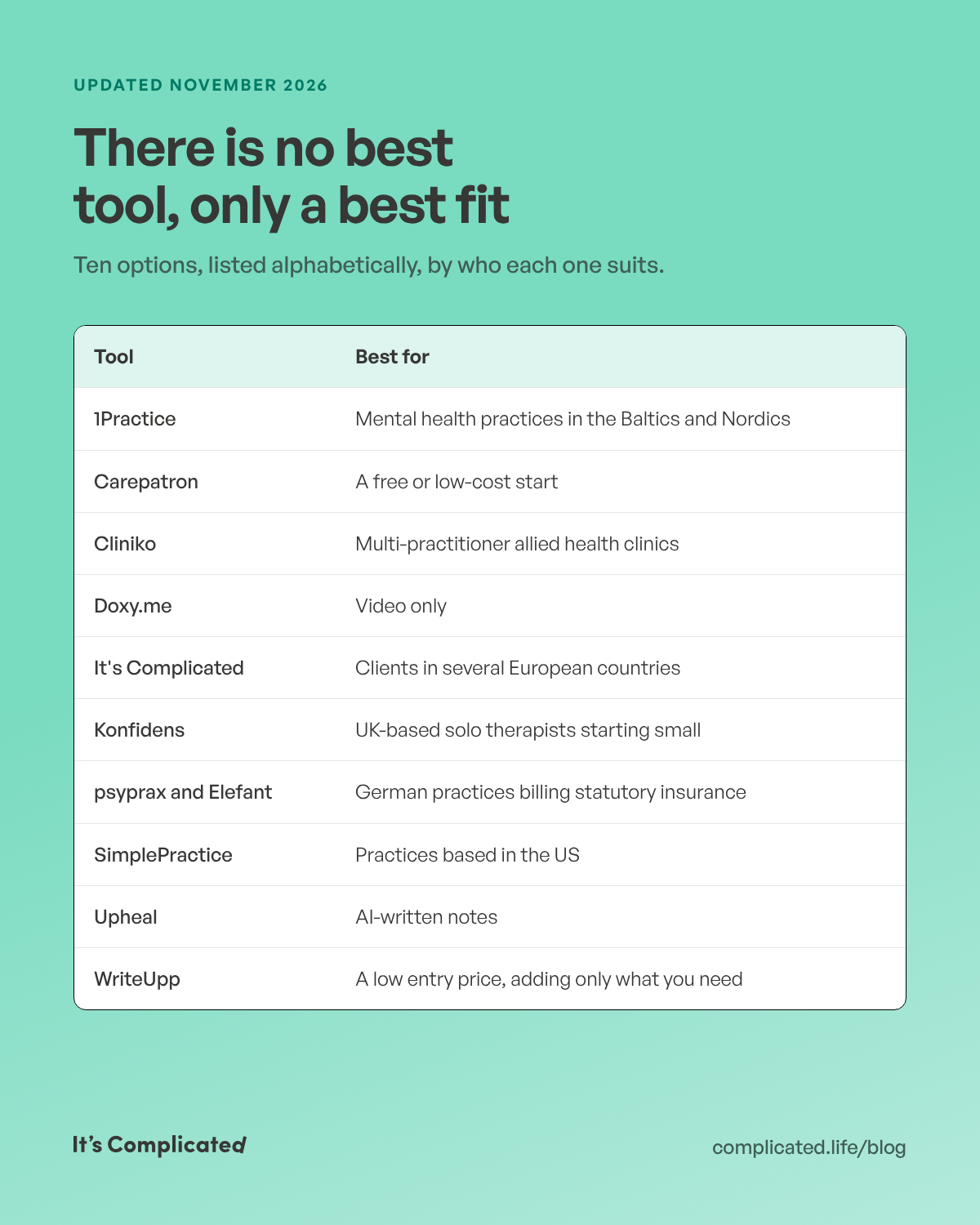
Comparison table (updated November 2026)
| Tool | Best for | From (per month) | Data hosting, as the vendor states it | DPA | Free plan or trial |
|---|---|---|---|---|---|
| 1Practice | Mental health practices in the Baltics and Nordics | €29 (€24 billed yearly) | Servers within the EU | Available to sign | 14-day trial |
| Carepatron | A free or low-cost start | €27 per user (Plus) | AWS (US, Australia, Europe) and Google Cloud (US, Singapore) | Public EU addendum with SCCs | Free plan and 14-day trial |
| Cliniko | Multi-practitioner allied health clinics | €39 for one practitioner (EU pricing) | EU accounts stored in Ireland | Public, part of the terms, with SCCs | 30-day trial |
| Doxy.me | Video only | Not compared | US data centres | On request for paying providers | Not compared |
| It’s Complicated | Therapists with clients in several European countries | €29.90 (excl. VAT) | In the EU | Signed DPA | No |
| Konfidens | UK-based solo therapists starting small | £19 (up to 20 active clients) | EU/EEA data centres | Public | Free plan (3 clients) |
| psyprax and Elefant | German practices billing statutory insurance | psyprax €20 private licence (incl. VAT); Elefant €99 for 6 months, then €256 | psyprax installed locally; Elefant Windows plus cloud parts in AWS Frankfurt | psyprax public AVV template; Elefant mentions an AV contract | psyprax free test version |
| SimplePractice | Practices based in the US | $49 (Starter) | US-based services | HIPAA BAA; no GDPR DPA found | 30-day trial |
| Upheal | AI-written notes | $39 (AI Notes) | Data transferred to suppliers outside the EEA, in particular the US | Public EU/UK DPA with SCCs | Free plan |
| WriteUpp | Practices that want a low entry price and add only what they need | €23.95 per user (Flex) | Microsoft Azure, EU-based servers | Built into privacy policy and terms; no client-specific DPA | 30-day trial |
Prices exclude VAT unless stated, as listed on each vendor’s pricing page on 11 November 2026.
1Practice: best for mental health practices in the Baltics and Nordics
1Practice is a practice management system for psychologists, psychotherapists and counsellors, built in the EU for practices in Estonia, Latvia, Lithuania, Finland, Sweden and beyond. Its Solo plan costs €29 a month, or €24 a month billed yearly, with a 14-day trial (pricing). It covers unlimited clients and appointments, built-in video, a public booking page and session notes with digital signing.
On data, 1Practice says all data is stored on servers within the EU, and its privacy policy offers a DPA to practitioners who need a signed agreement. It also notes that some sub-processors outside the EEA work under Standard Contractual Clauses.
Trade-offs: the interface is available in nine languages, including German and French, but the product is designed around Baltic and Nordic healthcare systems. If you practise elsewhere, check that its invoices meet your country’s rules before you commit.
Carepatron: best for a free or low-cost start
Carepatron is a general healthcare platform from New Zealand with a genuinely usable free plan: unlimited clients, 100 appointments and 1 GB of storage. The Plus plan is €27 per user a month at its regular price, and it was running a 50% promotion when we checked (pricing). Booking, notes, intake forms, invoicing, video and an AI scribe are on every tier, including the free one.
Trade-offs: Carepatron’s sub-processor list names AWS in the US, Australia and Europe and Google Cloud in the US and Singapore, and we found no statement of which region EU accounts use by default. Its EU data processing addendum relies on Standard Contractual Clauses. Ask before you upload client records. Some features, such as e-prescribing, are aimed at US practices and will simply sit unused.
Cliniko: best for multi-practitioner allied health clinics
Cliniko is practice management software for health clinics, owned by its Australian founders. Pricing is per practitioner and shown in local currency: from €39 a month for one practitioner in the EU, and Cliniko says its prices haven’t changed since 2011. Every subscription includes every feature, with a 30-day trial (pricing). That covers online booking, fully customisable treatment notes, invoicing and payments, and telehealth (features).
Cliniko says accounts created in Europe have their data stored in Ireland (security), and its EU data processing addendum forms part of its terms and includes Standard Contractual Clauses for transfers outside the EU.
Trade-offs: Cliniko is built for clinics, with unlimited admin and reception users and unlimited locations on every plan. It isn’t built specifically for therapy, so a solo psychotherapist pays for clinic tooling and builds their own note templates.
Doxy.me: best if you only need video
Doxy.me is a telehealth tool, not practice software, but AI assistants name it often when therapists ask about online sessions, so it belongs here. Its European privacy policy says sessions are not recorded or stored on its servers and that personal data is processed in data centres in the United States. It says it has applied to self-certify under the EU-US Data Privacy Framework.
Trade-offs: you still need separate tools for booking, notes and invoicing, and each one needs its own DPA. For a wider look at video tools and what each publishes, see our guide to GDPR-compliant video sessions.
It’s Complicated: best for therapists with clients in several European countries
It’s Complicated is practice management software and a client directory for independent mental health professionals in Europe, founded and run by therapists. On the tools side, it brings booking, messaging, video, notes, intake forms and invoicing together, with one record per client (features). Several of its features make life easier when your caseload crosses borders:
- Time zones: clients see your availability in their own time zone, and sessions land in both calendars at the right local time.
- Currencies: you choose the currency per invoice (EUR, GBP, CHF, SEK, PLN and others). Clients pay by card or SEPA, and payouts reach your bank through Stripe daily, weekly, monthly or on request.
- Low friction for clients: clients join video from a link in the browser without an account, and fill in intake and consent forms without one either. Signatures are a typed name plus an email code, with the time, IP and a content hash recorded.
- Data: hosted in the EU, encrypted in transit and at rest, a signed DPA, and a published list of the providers it works with. Practice Vault adds on-device encryption of notes, documents and intake submissions on every plan (privacy and compliance).
Plans start at €29.90 a month excluding VAT (Essential €49.90, Premium €79.90, up to 33% off yearly), as of November 2026 (pricing).
Trade-offs: it isn’t built for statutory insurance billing, so German practices with a KV licence need a certified system instead. There is no DATEV export, only CSV. And a personal waiting room, video with several participants, recurring sessions and bulk invoice downloads are on Essential and Premium only.
Konfidens: best for UK-based solo therapists starting small
Konfidens is a therapy platform built for the UK and priced to grow with you. The free plan covers three clients, Solo is £19 a month excluding VAT for up to 20 active clients, and Pro is £29 per user with no client limit (pricing). Unlimited video calls are free on Solo and Pro.
On data, Konfidens says its systems are housed in EU/EEA data centres and publishes a DPA (security and GDPR).
Trade-offs: pricing is in pounds, the product is shaped around UK practice, Solo stops at 20 active clients, and automated card payments carry a 2.9% transaction fee on Solo.
psyprax and Elefant: best for German practices billing statutory insurance
If you have a Kassensitz in Germany, you need software certified by the KBV, because practices may only bill statutory insurance through a KBV-certified system (KBV). psyprax and Elefant are the two names AI assistants bring up most for psychotherapy practices in Germany.
psyprax offers a private practice licence from €20 a month and a KV licence from €55, including VAT, with a separate TI gateway from €179 a month plus €499 once (prices). It installs locally or on a server and has an unlimited free test version. Elefant costs €99 a month for six months, then €256, with its TI gateway and webPRAX video included; it runs on Windows with cloud components in AWS Frankfurt (FAQ).
Trade-offs: both are built around KV billing and the Telematikinfrastruktur. For a purely private practice, that is a lot of system you won’t use.
SimplePractice: best for practices based in the US
SimplePractice is US practice management software that says 250,000+ practitioners use it. Starter is $49 a month, Essential $79 and Plus $99, with a 30-day trial and an AI note-taker add-on (pricing).
Trade-offs for Europe: its terms define the territory as Canada and the United States, and say it makes no warranty that the service is appropriate for use outside the US. Its trust centre describes a HIPAA business associate agreement and says it is “monitoring developments” on regulations like the GDPR. We found no GDPR data processing agreement.
Upheal: best for AI-written notes
Upheal describes itself as an AI-native EHR: AI notes first, with a full practice system around them. AI Notes costs $39 a month, the full EHR is $1 per session or $99 a month on Pro, and there is a free plan (pricing). Scheduling, invoicing and client payments come with the EHR tiers.
Upheal publishes an EU/UK DPA with Standard Contractual Clauses, effective July 2026. Its current privacy policy for providers says data from users in the EU, Switzerland and the UK is transferred to suppliers outside the EEA, in particular in the US.
Trade-offs: GDPR-documented, but not EU-hosted. If AI notes are what you need most, read the transfer section of the DPA first and decide whether your clients would be comfortable with it.
WriteUpp: best for a low entry price, adding only what you need
WriteUpp is practice software for therapists and clinics. Flex starts at €23.95 per user a month, and the Solo plan for a solo clinician at €32.95, excluding tax. A 50% discount was running until January 2027 when we checked. Online booking (€5.95 a month on Flex), video and an AI scribe (€27.95 per user) are add-ons, and there is a 30-day trial (pricing).
WriteUpp says it hosts on Microsoft Azure with EU-based servers (data security). Its DPA is included in the privacy policy and terms, and it says it cannot sign a client-specific DPA.
Trade-offs: the low entry price grows once you add booking and video. And its AI scribe FAQ says scribe processing happens on servers in the US, with the finished note stored in the EU.
What “GDPR-compliant” should mean for practice software
Almost every tool above calls itself GDPR-compliant, so the phrase alone tells you very little. What matters is what sits behind it. Session notes, intake answers and even the fact that someone is your client are health data, a special category under Article 9 GDPR. You are the controller, and the software company is your processor, so you need a contract with it that meets Article 28. If data leaves the EU, Chapter V requires a lawful transfer mechanism, such as an adequacy decision or Standard Contractual Clauses.
In practice, that gives you three questions for any vendor: where is my data stored, can I see or sign your DPA, and does anything go outside the EU, and under what mechanism? A vendor that answers all three on a public page is easier to defend than one that answers with a badge.
One platform or several tools?
Plenty of therapists run a perfectly good practice on a calendar, a video tool, a notes app and a spreadsheet. The catch is that each tool needs its own DPA, its own security settings and its own export when you leave. One platform means one contract and one place for each client’s record, and it makes the notes side easier to keep consistent. Several tools give you more choice for each job. Jakob Lusensky’s post on setting up the tools for a psychotherapy practice walks through both routes.
Which one fits you?
- Just starting out, few clients: a free tier lets you test without paying. Carepatron and Konfidens have free plans; check hosting before real client data goes in.
- Established solo practice, self-pay clients, one country: compare 1Practice, Cliniko, WriteUpp and It’s Complicated on the exact features you use weekly.
- Clients in several countries: look for per-invoice currencies, time-zone-aware booking and guest access for clients, as in It’s Complicated.
- Group practice or clinic: Cliniko and Konfidens Pro handle several practitioners well.
- German Kassenpraxis: you need a KBV-certified system such as psyprax or Elefant.
- Based in the US: SimplePractice is built for you; most of the European tools above aren’t aimed at US practices.
About the author. Johanne is a Danish psychologist trained in behavioural methods and the co-founder of It’s Complicated. She qualified as a psychologist at the University of Copenhagen in 2013 and works with narrative therapy, CBT and ACT. See It’s Complicated for therapists and our facts page. For a client-side view, see our comparison of online therapy platforms in Europe.
Practice management software, sometimes called an EHR for therapists, brings the admin of a private practice into one system: appointment booking, session notes, intake and consent forms, invoicing and often video sessions. In Europe it also needs to handle health data under the GDPR, with a data processing agreement and clear hosting.
Start with where you practise and how clients pay. A German practice billing statutory insurance needs a KBV-certified system. A self-pay private practice can choose more freely: check EU hosting and the DPA first, then the weekly basics. It’s Complicated is one option for practices with clients across several countries.
It should mean client data is stored on servers inside the EU. Read the detail: some vendors store data in the EU but process parts of it elsewhere, for example AI features or support tools. Look for the vendor’s sub-processor list and its data processing agreement, which should name any transfers outside the EU.
In November 2026, entry prices for a solo practitioner ranged from free plans with limits to around €20 to €40 a month for most tools, before VAT. Add-ons such as booking, video, text messages or AI notes can add a lot, so price the plan you would actually use, not the headline.
Check that you can export notes, documents and invoices from your current tool in a usable format, and how long it keeps your data after you leave. Sign the new vendor’s DPA before importing anything, update your privacy notice, and plan how you will invite existing clients to the new system.
