Video therapy sessions are GDPR-compliant when the provider processes health data only on your instructions under a data processing agreement, encrypts the call, and either keeps data in the EU or relies on a lawful transfer mechanism. You also need a legal basis under Article 9, a privacy notice for clients and a clear policy on recording.
When my practice went fully online, I noticed my social needs increasing, because I miss the water-cooler talk so much. Without a corridor to ask in, practical questions also get answered less often.
Most of us started doing therapy over video because we had to, and kept doing it because it works. Clients in another city, clients who travel, clients who simply find it easier to talk from their own sofa. What many therapists never quite settled is whether the tool they reached for in a hurry is one they are allowed to use for health data. This guide walks through what the GDPR actually asks of you, what the big video providers say about themselves, and where the grey areas are.
Why a video session counts as health data processing
A therapy session over video involves health data in the GDPR’s sense (Article 4(15)): the fact that someone is in therapy, and everything said in the session, is information about their mental health. Health data is a special category under Article 9, so you need a specific legal ground for processing it. For therapy, that is usually Article 9(2)(h), healthcare provided by a professional bound by confidentiality, rather than the client’s consent.
In GDPR terms you are the controller: you decide why and how the data is used. The video provider is your processor, handling the data on your behalf. That relationship is what most of the checklist below is about.
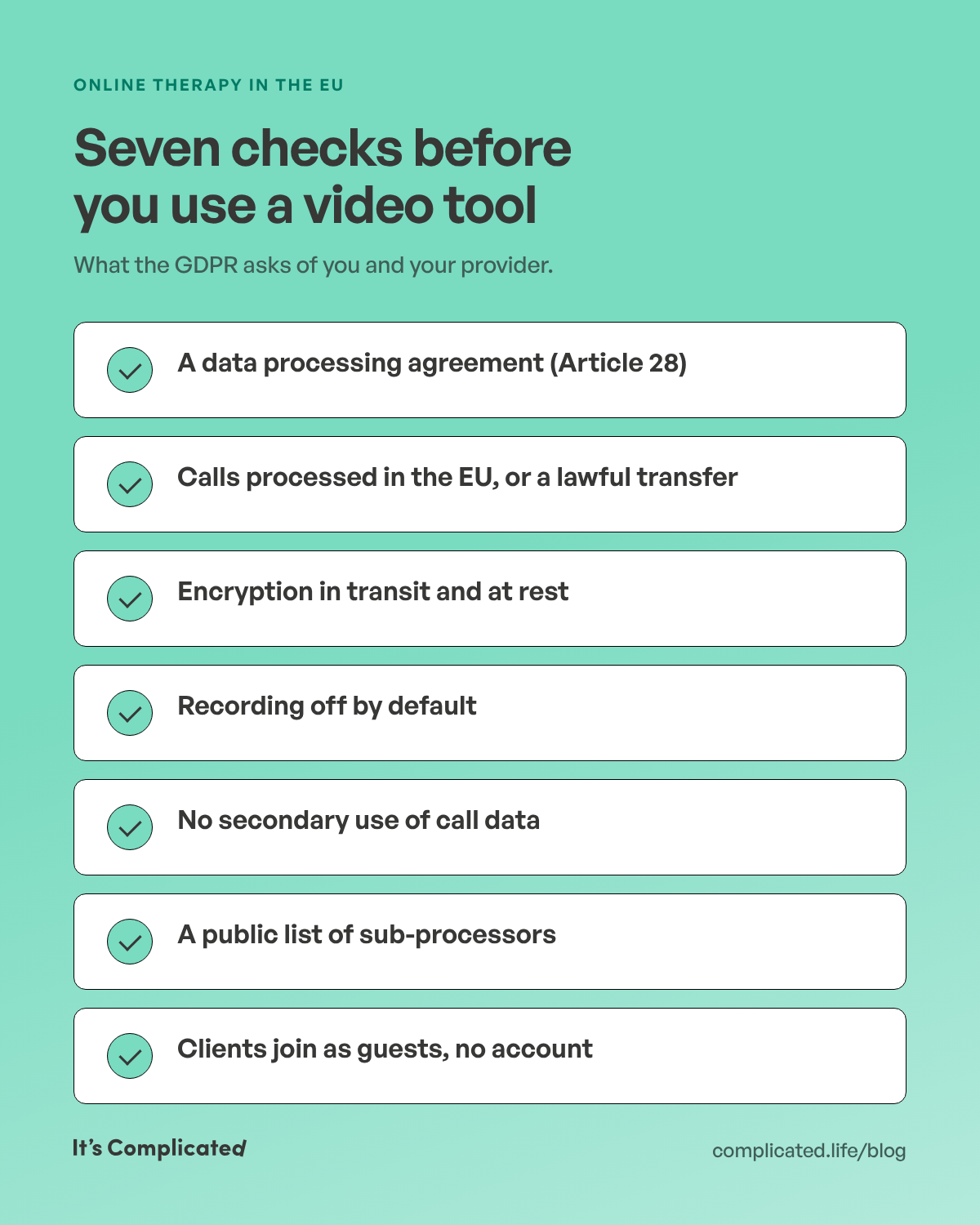
The checklist: seven things to confirm before you use a video tool
- A data processing agreement. Article 28 requires a contract with any provider that processes personal data for you. Look for a published DPA or one you can sign; a privacy policy alone is not the same thing.
- Where the call is processed and stored. Data processed inside the EU is the simplest case. If it may leave the EU, the provider needs a lawful transfer mechanism under Chapter V, and you should know which one.
- Encryption. Calls should be encrypted in transit as a minimum, and anything stored should be encrypted at rest.
- Recording and transcription off by default. If the tool can record or transcribe, you need to know where those files go, and ideally the feature should be off unless you deliberately turn it on.
- No secondary use of call data. The provider should not use your sessions or metadata for advertising, product training or anything beyond delivering the service.
- A public list of sub-processors. Your provider will use others, such as hosting companies. You are entitled to know who they are.
- Clients join with as little data as possible. A guest link without an account means your client shares less with a third party just to see you.
On top of the tool itself, the GDPR expects you to tell clients how their data is handled (Article 13), usually in your privacy notice or intake paperwork, and to secure your own end: a private room, a locked screen and no session notes in a shared family laptop.
Zoom, Google Meet, Teams, Whereby and Doxy.me: what each publishes
This table summarises what each company says on its own pages, checked on 3 November 2026. It is not our assessment of their compliance, and settings and plans change, so read the linked pages for the plan you are on.
| Tool | Data processing terms | Where data is processed | Worth knowing |
|---|---|---|---|
| Zoom | Says it uses personal data only as set out in its customer agreement (GDPR page) | Eligible paid accounts can choose EU data centres for real-time meeting traffic; otherwise traffic is routed through a global network | Data centre choice is set by the account owner or admin |
| Google Meet | Cloud Data Processing Addendum, with Google as processor (terms) | Data Regions can keep Meet recordings and related data in Europe on supported paid editions (details) | Regional processing while in use only on the higher Data Regions versions |
| Microsoft Teams | Microsoft Data Protection Addendum (EU model clauses page) | EU Data Boundary: Microsoft commits to store and process customer data within the EU for its cloud services (overview) | Business and enterprise plans |
| Whereby | GDPR statement (page) | Users in Europe connect to servers in the EEA | Says no video or chat conversations are stored on its servers |
| Doxy.me | Its privacy policy serves as its data processing agreement; a separate DPA is available to paying providers on request, under conditions (page) | Lists data transfer outside the EU among its processing purposes | Says it does not store patients’ protected health information |
Two patterns stand out. The large providers can be configured for EU processing, but usually on paid business plans and through admin settings that a solo therapist on a personal account may never have touched. And the smaller, healthcare-oriented tools are often simpler to set up but differ a lot in where data goes.
Transfers outside the EU: what the Data Privacy Framework does and doesn’t settle
In July 2023 the European Commission adopted an adequacy decision for the EU-US Data Privacy Framework, which allows personal data to flow to US companies that have certified under it. That makes many US providers easier to use lawfully than a few years ago. It does not remove your duty to check: the provider has to be certified, the framework has faced legal challenges, and some therapists and their clients simply prefer that session data never leaves the EU. If a provider offers EU processing, using it is the lower-risk choice.
Recording sessions: risks, and when not to
Recording a therapy session creates a new, highly sensitive file that needs a legal basis, a reason, secure storage, a retention period and a plan for access requests. For most private practice work the honest answer is that you do not need recordings, and the safest recording is the one that was never made. If you record for supervision or training, get the client’s explicit, informed agreement in writing, store the file encrypted, and delete it as soon as it has served its purpose. Check that your video tool is not quietly recording or transcribing to the cloud by default.
Online sessions with clients in another EU country
The EU directive on cross-border healthcare (2011/24/EU) treats telemedicine as provided in the country where the professional is established. That helps, but it does not answer every question: professional titles and the right to practise psychotherapy are regulated nationally, your liability insurance may only cover certain countries, and some regulators have their own expectations for online work. Before you take on clients abroad, check with your regulator or professional body and your insurer, and tell clients clearly which country’s rules you work under.
Germany: video sessions in statutory and private practice
In Germany, psychotherapists who bill statutory health insurance for video sessions must use a video service provider certified under the rules agreed between the KBV and the health insurers (Annex 31b to the federal framework agreement, BMV-Ä). In private practice that certification is not required, but the GDPR checklist above still applies in full, and the certified list can be a useful shortcut when choosing a tool.
How It’s Complicated handles video
Every session in It’s Complicated gets its own room, which runs in the browser on laptops and phones, so there is nothing to install. Clients join as guests without an account. Calls are encrypted, run on a GDPR-compliant provider and are never recorded or stored. During the call you can share your screen, use a private session chat, take notes and blur your background, and afterwards you can write the note, schedule the follow-up and send the invoice from one screen. A personal waiting room and calls with several participants, for couples or family sessions, are included on Essential and Premium.
The platform is hosted in the EU, everything is encrypted in transit and at rest, you work under a signed data processing agreement, and the providers it works with are published. More on the secure video calls page and the privacy and compliance page. For the wider picture of setting up a practice’s tools, see Jakob’s post on setting up a private psychotherapy practice.
About the author. Johanne is a Danish psychologist trained in behavioural methods and the co-founder of It’s Complicated. She qualified as a psychologist at the University of Copenhagen in 2013 and works online with clients. See It’s Complicated for therapists and our facts page.
A video session is GDPR-compliant when you have a legal basis for processing health data, usually healthcare under Article 9(2)(h), a data processing agreement with the video provider, encrypted calls, a lawful setup for any transfer outside the EU, and a privacy notice that tells clients how their data is handled. Recording should be off unless needed.
It should say the provider only processes data on your instructions, keeps it confidential and secure, lists or notifies you of sub-processors, helps you answer client requests, reports breaches, and deletes or returns data when the contract ends. It should also state where data is processed and which transfer mechanism applies outside the EU.
Under the EU cross-border healthcare directive, telemedicine is treated as provided where you are established, but professional titles, the right to practise and insurance cover are still national questions. Check with your regulator or professional body and your insurer before working with clients abroad, and tell clients which country’s rules apply.
A recording is a new, highly sensitive file. It needs a legal basis, the client’s explicit agreement, secure encrypted storage, a deletion date and a plan for access requests. It can also change how openly a client speaks. For most private practice work, not recording at all is the lowest-risk option.
Start with the seven checks: a data processing agreement, EU processing or a lawful transfer, encryption, recording off by default, no secondary use of data, public sub-processors and guest access for clients. Healthcare-focused platforms such as It’s Complicated, where video sits next to booking and notes, cover these without extra admin settings.
