
Brainspotting is a Gentle Approach to Healing Trauma and Emotional Blocks
When people think of trauma therapy, they often imagine long sessions of talking, analyzing, or trying to make sense of difficult experiences. But many clients describe something very different. They say, “I can feel something inside me, but I don’t have words for it.” Or “I’ve done so much talking already. I don’t know what else to say.”
Brainspotting was developed for exactly these moments.
Created by Dr. David Grand in 2003, Brainspotting emerged from his work with EMDR when he noticed something unexpected. A client’s eye position seemed to connect directly to the deepest emotional and physical activation in their body. That observation grew into a therapeutic method that helps people access and process what is stored beneath language, in the parts of the brain that shape emotion, memory, and instinctive responses.
Today, Brainspotting is used worldwide to support trauma recovery, emotional regulation, performance enhancement, and healing for people who struggle to verbalize what they feel.
Then what exactly is Brainspotting?
At its core, Brainspotting is based on a simple but powerful idea:
Where you look affects how you feel.
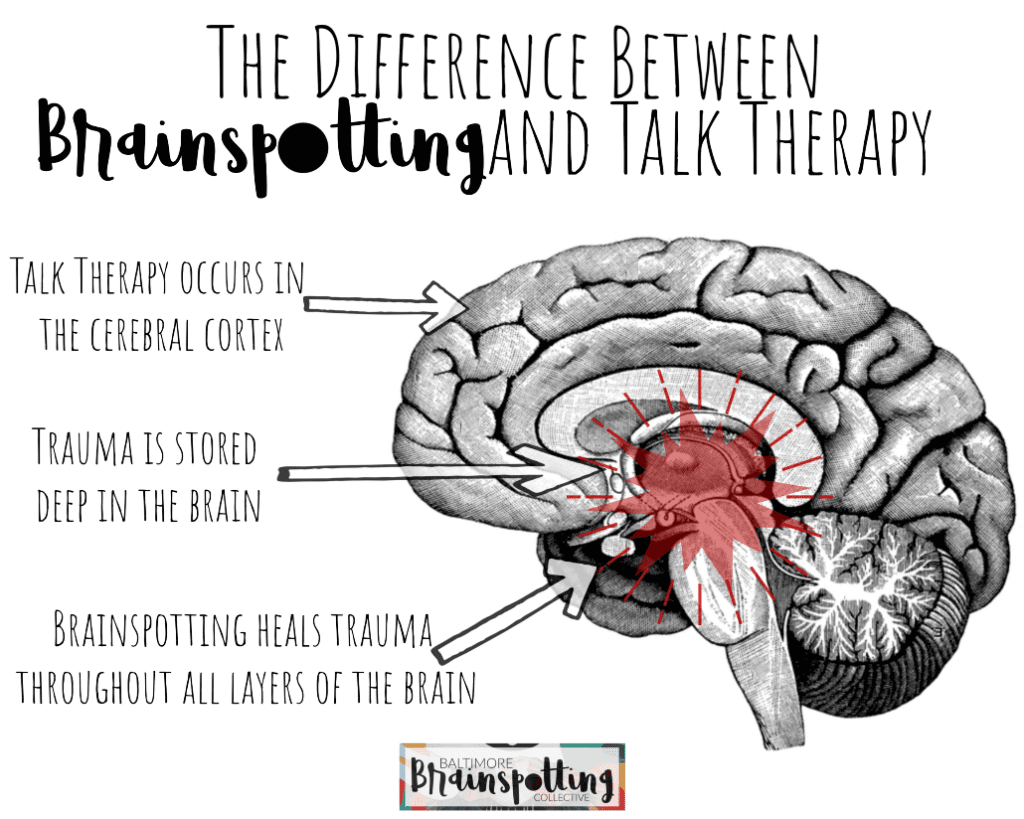
A “brainspot” is a specific position of the eyes that corresponds with the neural network holding an emotional or physical activation. Brainspotting does not process trauma through eye movements. Instead, the eye position helps locate the part of the brain where the experience is stored. Once we find the spot, the brain begins to process the material from the inside out, in its own natural and efficient way.
The therapist helps the client identify this spot by observing subtle cues like eye wobbles, facial shifts, body activation, or a sudden change in internal sensation. Once the spot is identified, the client holds their gaze there while remaining attuned to their internal experience.
The magic happens because Brainspotting engages the brain’s natural self-healing capacity. Much of this work occurs below conscious thinking. Although some clients may talk through their processing others may often feel shifts in their body, emotions or energy and process in silence. They might feel heat, tingles, pressure or sudden waves of emotion. It is bottom-up processing that unfolds organically and often quietly.
The role of Attunement
One of the most unique elements of Brainspotting is something called dual attunement. The therapist stays closely connected with the client’s internal experience, pacing the process safely and gently. This level of presence creates a regulated, grounded relational space that allows the client’s nervous system to move through material that previously felt stuck. Witnessing the clients process and adding meaning to their story.
Brainspotting can be done with music that supports bilateral stimulation or in silence. It can be done with the therapist using a pointer or simply by gazing. It can be done in a highly supported way or with more independence depending on the client’s comfort and needs.
What happens during a session?
A typical Brainspotting session often feels quieter and more internally focused than traditional talking therapy.
The process usually looks like this:
- You identify an issue, emotion or sensation you want to work on.
- The therapist helps you find the eye position linked to that activation.
- You rest your gaze there and simply notice what happens inside.
- The therapist stays attuned and grounded with you throughout.
- Processing unfolds naturally, without pressure or force.
Some people process emotions. Some experience memories surfacing gently. Some feel physical sensations change. Others simply feel calmer and more settled. There is no right or wrong way to experience Brainspotting.
Because much of the processing is subcortical, meaning below conscious thought, clients often describe it as deep, surprising, or even hard to describe in words.
During a session, your therapist helps you find the eye position (or brainspot) that activates the emotional or physical “felt sense” of what you want to work on.
Here’s what’s happening internally:
1. Your eyes connect directly to your nervous system
The ocular nerves are linked to the vagus nerve, which controls both the stress activation response and the calming, rest-and-digest system.
2. A brainspot activates the deeper layers of the brain
This includes:
- the limbic system (emotions, memory)
- the brainstem (survival responses)
- the midbrain (where unprocessed trauma often lives)
These areas operate beneath conscious thinking; so Brainspotting allows access to what talk therapy sometimes can’t reach.
3. Dual attunement guides the process
Your therapist tracks both:
- Your emotional and physical responses, and
- Your relational connection together
This creates a safe container for processing.
4. Bilateral music supports regulation
Listening to gentle sounds alternating left and right helps the brain integrate information and stay grounded.
Because Brainspotting bypasses the thinking cortex, you don’t need to analyze, explain, or even talk much.
You can speak as much or as little as feels right.
What can Brainspotting help with?
Brainspotting has been used to support many types of difficulties, including:
- Trauma and PTSD
- Anxiety and chronic stress
- Emotional overwhelm
- Relationship and attachment wounds
- Somatic symptoms
- Unexplained emotional blocks
- Performance issues in sports, creative work and public speaking
- Feeling stuck in patterns you cannot think your way out of
It is especially helpful for people who struggle to verbalize what is happening inside or for those who feel “I’ve talked about this a hundred times, but something inside still hasn’t shifted.”
Who Can Benefit?
Brainspotting is helpful for anyone who has experienced emotional or physical trauma, but also for people who:
- overthink or feel stuck in their head
- anger, aggression or frustration
- struggle with anxiety or fear
- deal with chronic pain or fatigue
- face procrastination, avoidance, or blocks
- have impulse control difficulties
- experience performance anxiety (creative, athletic, public speaking)
- prefer a method that doesn’t require talking in detail
- work in fields where confidentiality limits what they can discuss
Because it works directly with the body and nervous system, Brainspotting helps even when you can’t fully express or explain what you’re feeling.
Why clients often love Brainspotting
Brainspotting is gentle but powerful. Clients often appreciate that:
- They do not need to retell painful memories in detail
- They are not pressured to talk when they have no words
- Their body guides the process naturally
- They can process difficult experiences without becoming overwhelmed
- They feel deeply attuned to and supported throughout
Many describe it as feeling like therapy is finally reaching the part of them that talking has never been able to reach.
How Effective Is Brainspotting?
Brainspotting is widely used to help people:
- reprocess traumatic memories
- reduce emotional distress
- shift long-standing patterns
- improve emotional regulation
- release stored tension or pain
- access new insights and decisions
In many cases, change happens faster than with talk therapy alone because the process reaches the neurological roots of the issue.
Clients often report:
- increased self-awareness
- feeling lighter or clearer
- less emotional reactivity
- breakthroughs with issues they’ve struggled with
- new ways of seeing old situations
- improved emotional balance
Some people experience noticeable shifts after 1–2 sessions, while others use Brainspotting alongside talk therapy for deeper or ongoing work.
Online Brainspotting: Does It Work?
Yes. Brainspotting adapts extremely well to online therapy.
Because the therapist’s focus is on your face, eyes, and subtle responses, video sessions allow for deep attunement.
In fact, with the camera close to your face, some people feel even more seen and supported.
There’s no need for physical contact; just a strong therapeutic relationship, presence, and attunement.
At its heart, Brainspotting is about connection. It is about helping people access the places inside that hold pain, fear, shame, tension or confusion, and allowing those places to move toward healing in a way that feels safe and supported.
For clients who feel stuck, overwhelmed or lost for words, Brainspotting offers a gentle doorway into deeper healing. And for therapists, it offers a powerful method that honours both the wisdom of the body and the importance of human connection.
Ready to Try Brainspotting?
If you sense that something in your body, mind, or past is holding you back and talking hasn’t been enough, Brainspotting may be the approach that finally helps things shift.
You can book an intake session for resource Brainspotting at www.clarina.co.za or on It’s Complicated
About the Author
Clarina du Plessis is a Integrative Relational Cousellor and the founder of Psychcare Private Practice in South Africa. She specialises in trauma-informed and integrative wellness techniques. With years of experience supporting clients through emotional blocks, loss and stress she is passionate about helping people. Clarina integrates counselling techniques with compassion and presence, guiding clients toward lasting emotional resilience and personal growth. Find out more at: www.clarina.co.za or on her It’s Complicated profile.
References
- About BSPI. (n.d.). In Brainspotting International. Retrieved from http://www.brainspottinginternational.org/about-bspi
- Beneficial Uses of BSP. (n.d.). In Brainspotting International. Retrieved March 30, 2015, from http://www.brainspottinginternational.org/about-bspi/beneficial-uses-of-bsp
- Grand, D. (2013). Brainspotting: the revolutionary new therapy for rapid and effective change. Boulder, CO: Sounds True, Inc.
- Rigley, C. (2009, March 25). Eye see you Brainspotting: a cure-all for psychological trauma or parlor trick? New Times, 23(34). Retrieved from http://www.newtimesslo.com/news/2253/eye-see-you
- Terrell, D. (2009). What is Brainspotting? How does it compare to EMDR therapy?. In San Diego Trauma Therapy. Retrieved from http://www.sandiegotraumatherapy.com/emdr-articles/terrell-brain-spotting.htm
- What is brainspotting? (n.d.). Brainspotting. Retrieved from http://www.brainspotting.pro/page/what-brainspotting
