How It's Complicated works
1
Find your therapistUse our free matching service for personal recommendations, or browse our network of 2,500+ therapists yourself.
2
Create your free accountSign up in under 2 minutes. All you need is an email and a password, and you're ready to go.
3
Start therapyReach out to your therapist and book your first session within 24 hours. Online or in person, in 60+ languages.
Learn more about Tourette syndrome
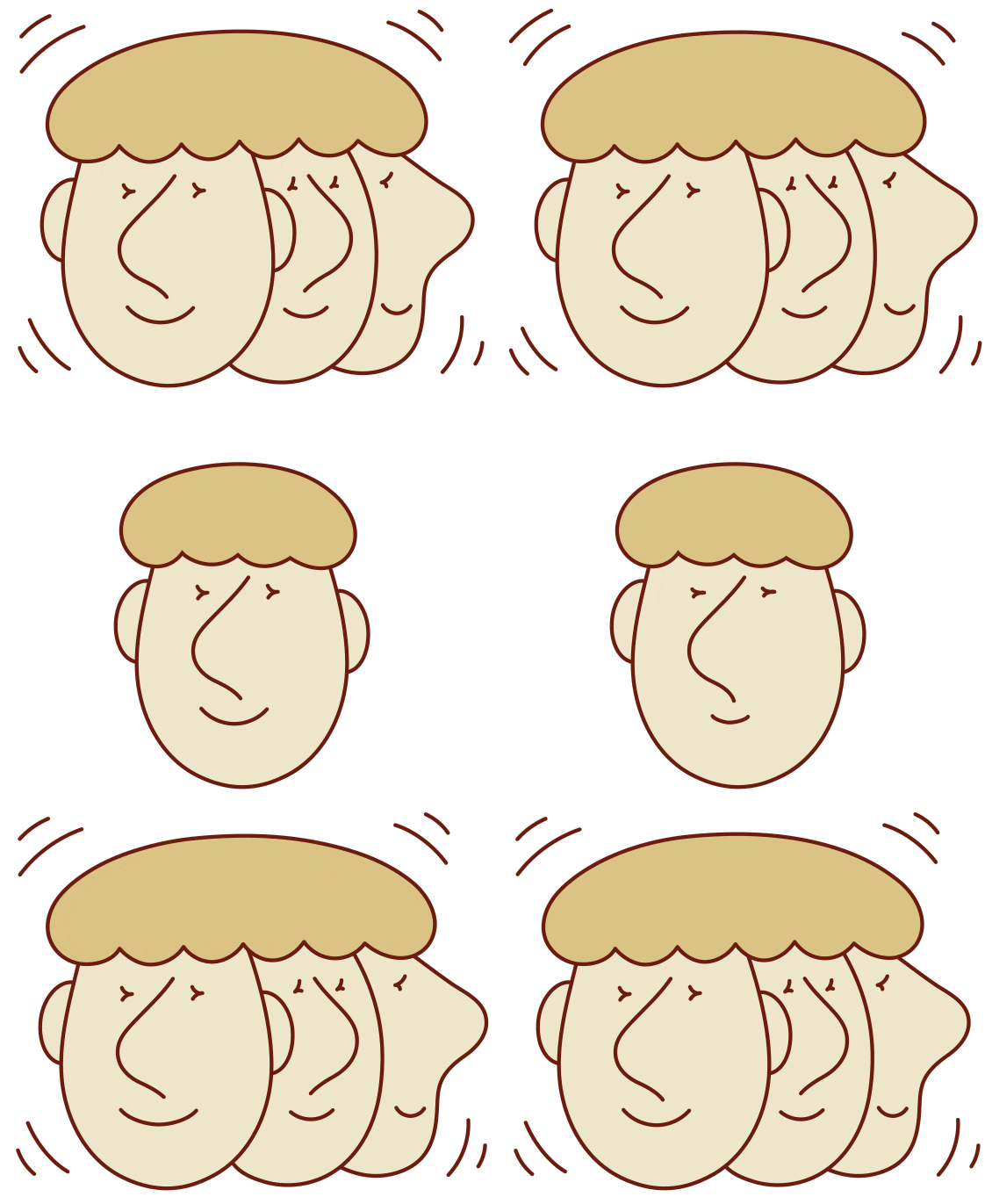
Tourette syndrome (TS) is a neurodevelopmental condition characterised by multiple motor tics and at least one vocal tic, present for more than a year, with onset in childhood or adolescence. Recognised in the DSM-5, it involves repetitive, involuntary movements or sounds that may be temporarily suppressed with effort but not permanently controlled. Common motor tics include eye blinking, head jerking, and facial grimacing; common vocal tics include throat clearing, sniffing, and grunting. A widely held misconception is that Tourette syndrome invariably involves shouting obscenities: this feature, known as coprolalia, affects only a minority of people with the condition. For many people, tic severity reduces through adulthood, though co-occurring conditions such as OCD (obsessive-compulsive disorder) and ADHD (Attention Deficit Hyperactivity Disorder) are common and often have a greater impact on daily life than the tics themselves.
Tourette syndrome varies considerably in severity and presentation. The following are the most commonly reported features.
Motor tics
- Simple motor tics: eye blinking, facial grimacing, head or shoulder jerking, nose twitching
- Complex motor tics: more coordinated sequences of movement, such as touching objects, jumping, or obscene gestures (copropraxia)
Vocal tics
- Simple vocal tics: throat clearing, sniffing, grunting, humming
- Complex vocal tics: repeating words or phrases, involuntary repetition of others' words (echolalia)
Other common experiences
- A premonitory urge: a sensation before a tic that is relieved by performing it
- Increased tic frequency under stress, excitement, or fatigue
- Anxiety, low self-esteem, or social difficulties related to tics
- Co-occurring ADHD, OCD, or anxiety
Psychological support for Tourette syndrome focuses on the emotional and social impact of the condition, tic management, and the assessment and treatment of co-occurring conditions.
- CBT (Cognitive Behavioural Therapy) CBT for Tourette syndrome includes Habit Reversal Training (HRT) and Comprehensive Behavioural Intervention for Tics (CBIT), which are among the most evidence-based psychological approaches for reducing tic frequency and impact.
- Clinical psychology Clinical psychologists assess the full neurodevelopmental picture, including co-occurring conditions, and design tailored interventions for the person's specific difficulties.
- Psychiatry Psychiatrists can assess for medication options to reduce tic severity and manage co-occurring conditions such as ADHD or OCD where appropriate.
- Counselling Counselling supports the emotional impact of living with Tourette syndrome, including anxiety, social difficulties, and the effect of the condition on relationships, school, or work.
It's Complicated is a therapist-founded mental health platform connecting clients with verified practitioners in over 60 languages. We work with over 2,500 vetted therapists, with in-person availability in Berlin, Amsterdam, Barcelona, Lisbon, Vienna, and other major cities, alongside online sessions across the continent.
Finding a therapist or psychologist with specific experience in Tourette syndrome, including its co-occurring conditions, requires a more targeted search than a general directory provides. Our matching service is built to remove that friction. You complete a short survey, our psychologists combine data-driven insights with human judgement to identify the right practitioners for your situation, and you choose from a shortlist of strong candidates. You can also browse our directory directly if you'd prefer to choose yourself.
Get matched with a practitioner who specialises in Tourette syndrome, or browse the directory.